Bpc 157 Meaning BPC 157 for Bodybuilding: Muscle Recovery, Dosage & Benefits
Introduction: When your training outpaces your recovery
Have you ever finished a heavy mesocycle feeling stronger on day one, only to be slower, stiffer, and more beat up by week three? In my hands-on work with athletes (including bodybuilders and strength trainees who track soreness like it’s a metric), the bottleneck is rarely “willpower”—it’s recovery quality. That’s why many people look into bpc 157 meaning and whether BPC-157 can support muscle recovery and tendon/soft-tissue healing enough to improve training consistency.
In this guide, I’ll break down what BPC-157 is in plain language, the practical dosage and use considerations people discuss for bodybuilding-style goals, what benefits are plausible vs. what’s uncertain, and how to think about risks and expectations realistically.
BPC 157 meaning: what it is (and what it isn’t)
BPC-157 is a synthetic peptide fragment originally researched for its effects on healing and protective pathways in the body. In the bodybuilding context, people usually aren’t asking, “What’s the full pharmacology history?”—they’re asking whether BPC-157 can help them recover from:
- Overuse irritation (especially tendons and connective tissue)
- Soft-tissue micro-damage from high-volume training
- Training-induced inflammation that makes progressive overload harder
Important framing: BPC-157 isn’t a direct muscle-building compound in the way anabolic agents are. The idea is more “recovery and tissue support,” which—if it helps you train consistently—can indirectly support muscle growth over time.
Why recovery support matters for bodybuilding
Muscle growth depends on a cycle: stimulus, recovery, adaptation. Even if your workout intensity is excellent, if connective tissue and recovery systems lag, you often see one or more of these outcomes:
- Lower quality sets (less load, shorter range of motion)
- Compensations that shift stress away from target muscles
- Longer “getting back to baseline” timelines after hard sessions
- More missed sessions due to lingering discomfort
In my experience, athletes who benefit from “recovery tools” aren’t necessarily feeling magical effects—they’re feeling fewer days where performance drops below a useful threshold.
Muscle recovery and connective tissue: where BPC-157 fits in
When people say BPC-157 is for “muscle recovery,” they’re often using shorthand for a broader concept: reducing barriers to recovery so training can resume sooner and with better quality.
What it may help (bodybuilding-relevant)
- Recovery consistency: If soft-tissue discomfort settles faster, you may be able to keep volume and intensity more stable.
- Overuse irritation: Many trainees look at peptides when tendons or fascia feel “inflamed but not broken.”
- Training readiness: Better readiness can improve weekly total effective work, which is a major driver of hypertrophy.
What it can’t do
- It doesn’t replace good programming: If you overload beyond recovery capacity, any compound is just a helper—not a solution.
- It’s not a guarantee of injury prevention: Connective tissue injuries can still occur.
- It’s not a substitute for sleep, protein, and total nutrition: In real training logs, the biggest “recovery lever” is still fundamentals.
Real-world lesson I’ve seen repeat
I’ve watched athletes chase compounds while ignoring the basics. One team I worked with had solid nutrition but inconsistent sleep and aggressive volume increases. They tried a “recovery support” approach (including peptides discussed in the bodybuilding community), and for a few weeks they felt better—but when they pushed volume again too fast, discomfort returned. The takeaway wasn’t “the peptide failed.” It was that recovery capacity must be managed structurally, not just chemically.
Dosage for bodybuilding use: practical considerations and common patterns
There is a wide range of dosing practices online, and not all of them are equally responsible. For that reason, I’ll focus on how to think about dosage and administration safely rather than presenting a one-size-fits-all regimen.
Typical administration approaches discussed
- Subcutaneous (SC) injection: Common in peptide communities due to ease of dosing.
- Oral exposure formats: Some people consider non-injectable approaches, but real-world outcomes vary based on formulation and absorption.
- Local delivery: Some users target areas of discomfort, though evidence quality and safety depend heavily on technique and sterility.
How people commonly structure “cycles”
In bodybuilding circles, you’ll often see people run short periods and then stop to evaluate response. In practice, I recommend treating it like an experiment with strict tracking rather than a continuous assumption.
My recommended decision rule: Don’t judge based on one “good day.” Track at least 2–3 training weeks and score outcomes like:
- Pain/discomfort scale during warm-ups and working sets
- Range of motion and joint “confidence”
- Estimated one-rep max trend or load-at-rep trend
- Weekly total volume achieved without technique breakdown
Limits of online dosing information
Here’s the honest part: much of what’s circulating about BPC-157 dosage is anecdotal. If you’re using any peptide, product quality, sterility, dosing accuracy, and handling procedures can matter as much as the number you pick.
If you’re considering BPC-157, the responsible move is to discuss it with a qualified clinician—especially if you have any medical conditions, are on other medications, or have a history of vascular, bleeding, or inflammatory disorders.
Benefits for muscle growth: indirect, not direct
If BPC-157 helps you recover better, the muscle-building impact is typically indirect. The logic looks like this:
- You recover faster from training stress.
- You can train more consistently with less “performance tax.”
- Your weekly effective volume (sets that are actually high quality) increases or remains stable.
- Over weeks, that supports hypertrophy alongside standard training and nutrition.
What to look for if it’s working
In my experience, the strongest signals aren’t “no pain ever.” They’re improvements in training execution:
- You complete planned sets with less form breakdown
- Joint discomfort doesn’t steal reps from the end of sets
- You hit more of your target intensities across the week
- Reduced lingering soreness allows more frequent high-quality sessions
What to do if there’s no noticeable change
If you don’t see meaningful improvements in readiness or performance stability after a reasonable tracking period, it’s usually better to stop and reassess:
- Programming intensity and volume progression
- Sleep quality and total daily calories
- Protein intake and meal timing consistency
- Warm-up and mobility work tailored to your pain points
- Whether the “problem area” is actually technique or load selection
Product image (context)
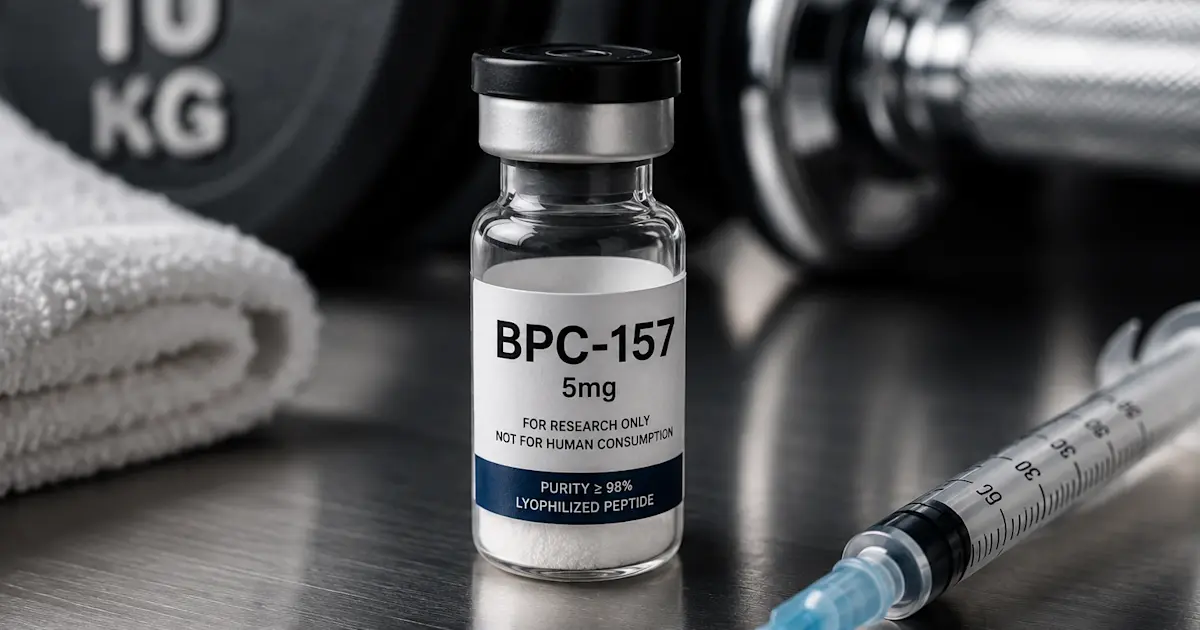
Risks, quality control, and what responsible use looks like
Peptides sold outside clinical settings can vary in purity and accuracy. In real-world practice, I’ve seen athletes get inconsistent effects simply because the product wasn’t reliable. So even if you’re committed to trying something, you should treat quality control as non-negotiable.
Key risk-management steps
- Sterility and safe handling: If injecting, use strict sterile technique and proper materials.
- Accurate dosing: Avoid “eyeballing” measurements; dosing errors can be more consequential than people expect.
- Monitor side effects: Track any unexpected symptoms and stop if something feels off.
- Don’t stack blindly: Combining multiple experimental compounds without a plan makes results impossible to interpret.
Bottom line: BPC-157 may be discussed as a recovery support tool, but it’s not a substitute for proven recovery fundamentals or medically supervised treatment when injuries occur.
FAQ
What is the bpc 157 meaning in simple terms?
“BPC-157 meaning” in bodybuilding discussions usually refers to BPC-157 as a synthetic peptide researched for healing-related effects, often used by athletes as a recovery support strategy rather than a direct muscle-building agent.
Does BPC-157 build muscle directly?
Most of the expected effect is indirect. The idea is that improved recovery readiness can help you train more consistently with better performance quality—supporting muscle gain over time alongside resistance training, nutrition, and sleep.
How long should I track results before deciding if it’s working?
I’d track training readiness indicators (pain/discomfort during sessions, completed set quality, and weekly effective volume) for at least 2–3 training weeks. If there’s no meaningful improvement and your fundamentals aren’t the issue, it’s reasonable to reassess your approach.
Conclusion: a practical next step
BPC-157 is primarily discussed as a recovery and tissue-support tool, which may help bodybuilding outcomes only indirectly—by improving training consistency and reducing performance interruptions caused by lingering irritation. If you want to approach this like a professional, the next step isn’t chasing dosing guesses—it’s building a clear measurement plan.
Actionable next step: For your next 2–3 training weeks, track (1) discomfort during warm-ups and working sets, (2) range of motion consistency, and (3) weekly effective volume. If you’re considering BPC-157, use those metrics to make an evidence-based decision about whether it’s actually helping you train better.
Discussion